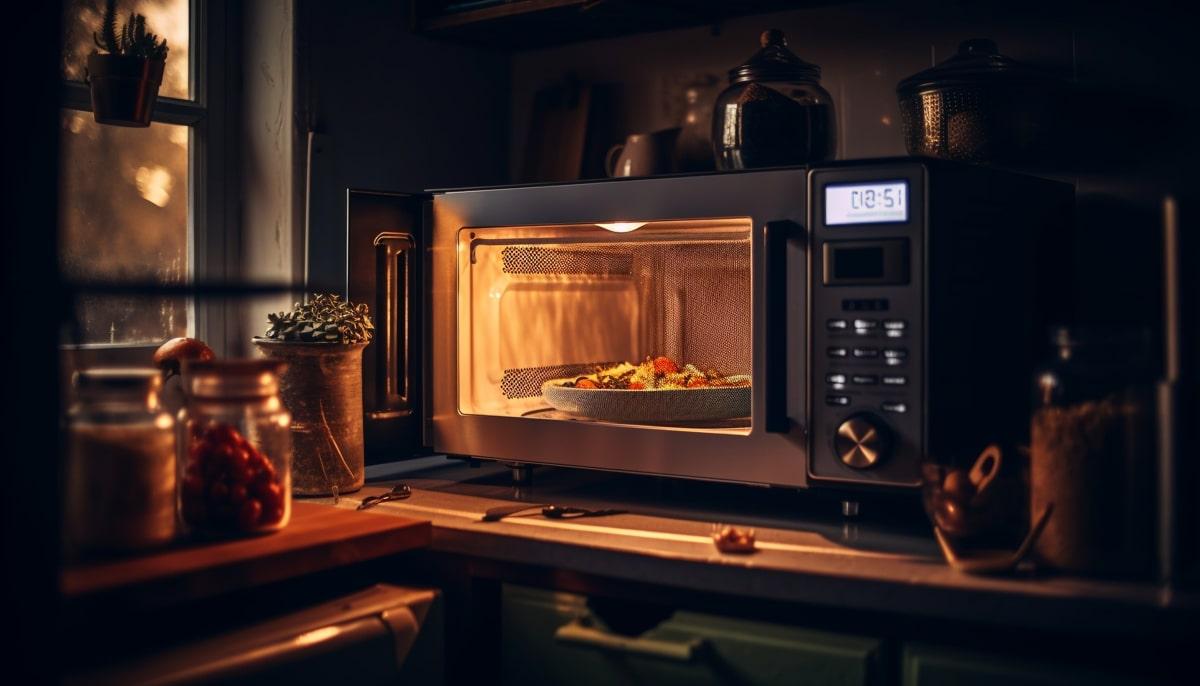
You put last night's rice in the microwave. Two minutes later the edges are hard as pebbles, but the middle is still cold. Or you defrost a packet of rui fish and find the outside turning grey while the center is still frozen solid. Sound familiar?
An inverter microwave oven is designed to fix exactly this problem. Instead of switching full power on and off, it delivers steady, adjustable power the whole time, so food heats more evenly.
What Is an Inverter Microwave Oven?
An inverter microwave oven is a microwave that uses an electronic power-control circuit to deliver continuous, adjustable heating. When you select 50% power, it actually runs at half strength the whole time, instead of alternating between full power and no power.
The word "inverter" refers to that control circuit. It regulates how much microwave energy reaches your food.
Microwaves in Bangladesh generally come in a few types:
Solo microwave (basic heating and defrosting),
Grill microwave (adds a heating element for crisping),
Convection microwave (works like a small oven), and inverter.
Inverter is a power technology, not a separate category. You'll find it in solo, grill, and convection models.
Several major brands sell inverter models here, including Panasonic, Sharp, Samsung, and LG. Availability changes often, so always confirm that the exact model you like has inverter technology written in its specifications.
How Does an Inverter Microwave Oven Work?
The easiest way to understand an inverter microwave is to first see what a normal one does, and why that causes problems.
How a Regular Microwave Controls Power
Inside every microwave is a part called the magnetron, which produces the energy that heats your food. In a conventional microwave, the magnetron can only run at full power. So how does it manage "medium" or "low" settings?
It cheats. It turns on at full blast, switches off, then turns on again, over and over. At "50% power," it might run full power for 15 seconds and then rest for 15 seconds.
The problem is that during each full-power burst, the outer parts of the food get blasted with energy. During the pause, heat slowly spreads inward. The result is hot spots, dry edges, and cold centers.
How Inverter Technology Delivers Steady Power
In an inverter microwave, a modern electronic circuit replaces the heavy transformer found in older designs. This circuit can adjust the magnetron's output smoothly, like turning a dimmer knob instead of flicking a switch.
That means 50% power really is 50% power, continuously. Your food receives gentle, constant energy, which gives heat time to spread through it naturally.
This changes how the food turns out. Rice stays soft instead of drying at the corners. Fish and chicken thaw without cooking on the outside. Curries reheat without splattering or forming a tough skin on top.
A Simple Everyday Analogy
Think of driving on a busy Dhaka road. A conventional microwave is like a driver who floors the accelerator, then hits the brake, then floors it again. You get where you're going, but it's jerky and uncomfortable.
An inverter microwave is like a driver who holds a steady, smooth speed. Same destination, much gentler ride, and your food is the passenger.
Inverter vs Conventional Microwave: What's the Difference?
Here's a side-by-side look:
|
Feature
|
Inverter Microwave
|
Conventional Microwave
|
|
Power delivery
|
Continuous and adjustable
|
Full power cycling on and off
|
|
Heating evenness
|
More even
|
Hot spots are common
|
|
Defrosting
|
Gentle and more uniform
|
Edges may start cooking
|
|
Energy use
|
Can be more efficient at lower power settings
|
Similar overall, less efficient at low settings
|
|
Weight and size
|
Usually lighter, more cavity space
|
Heavier transformer, bulkier body
|
|
Typical price in BD
|
Higher
|
Lower
|
|
Best for
|
Frequent cooking, defrosting, families
|
Basic reheating, tight budgets
|
The takeaway: If you use your microwave every day for reheating rice and curry, defrosting fish or meat, or cooking for a family, an inverter model is worth serious consideration. If you only warm milk or tea once in a while, a conventional microwave does the job well enough at a lower price.
Key Features of Inverter Microwave Ovens
Inverter models vary by brand, but these are the features you'll most often see.
Precise power levels and gentle defrost. Because power is continuous, low settings work as they should. Many models include a dedicated defrost mode for meat, fish, and bread that handles thawing carefully.
Auto-cook and sensor menus. Many models include preset programs for everyday foods such as rice, vegetables, and reheating. Some are designed with Indian and South Asian dishes in mind. Check the menu list before buying, since presets differ from model to model.
Lighter design with more cavity space. Without the bulky transformer, inverter microwaves are often lighter and can offer more usable space inside for the same outside size. That's useful in smaller kitchens.
Combination modes. Some inverter models also include grill or convection functions, so one appliance can reheat, grill kebabs, and bake a simple cake. This depends entirely on the model.
Everyday conveniences. Look for a child lock, a turntable (or a flat-bed design that removes it), and an easy-clean interior.
Extras. A few models offer steam cooking or air fry functions. These are nice bonuses, but they raise the price, so only pay for what you'll actually use.
Benefits of an Inverter Microwave for Bangladeshi Homes
Better defrosting of fish, chicken, and beef. Many of us buy meat and fish in bulk and freeze it. Thawing it in a regular microwave often leaves cooked patches and frozen centers. An inverter's gentle, steady power thaws food more evenly, so you can start cooking sooner without the rubbery edges.
Even reheating of rice, biryani, khichuri, and curries. Leftovers are part of life in every Bangladeshi household. Inverter models tend to warm rice, biryani, and khichuri more uniformly, with fewer dried-out edges. Curries heat through without bubbling over.
Better texture and taste. Gentler heating helps food keep its moisture, which usually means softer vegetables, juicier chicken, and rice that tastes fresher. To be clear, this is about texture and taste. Don't expect miracle health claims from any microwave.
Voltage fluctuation: what it helps and what it doesn't. Power ups and downs are a reality in many areas. Inverter circuits manage power more smoothly internally, and some brands say their models handle minor variations better. But an inverter is not a voltage protector. If your wiring is old or your voltage swings widely, a good stabilizer is still smart insurance for your investment.
Made for apartment kitchens. In Dhaka and Chattogram, counter space is precious. A lighter microwave with a roomier interior for its size makes better use of limited space alongside your essential kitchen gadget. .
Are There Any Drawbacks? Who Should Skip It?
No appliance is perfect, and an inverter microwave is not for everyone.
Higher upfront cost. You'll typically pay more than for a basic microwave of the same size. If repairs are needed, the electronic parts can also cost more to replace.
Service availability. Advanced circuit repairs need trained technicians. In big cities, service centers are easy to find. In smaller towns, it may take longer, so check the brand's service network near you before buying.
Not always necessary. If you mostly warm a cup of milk or tea, or heat a snack now and then, you probably won't notice much difference. A simple microwave will serve you well and save you money.
Our honest advice: buy an inverter model if you cook, defrost, or reheat several times a week. Skip it if your usage is light and your budget is tight.
Inverter Microwave Price in Bangladesh and Popular Brands
Microwave oven prices vary by brand, capacity, and features. The ranges below are approximate and meant only as a guide to help you compare microwave oven prices and understand what you can expect to pay for different types and models.
|
Brand
|
Typical Capacity
|
Indicative Price (BDT)
|
Typical Warranty*
|
|
Panasonic
|
20L to 27L
|
15,000 to 30,000
|
Check with dealer
|
|
Sharp
|
20L to 25L
|
12,000 to 25,000
|
Check with dealer
|
|
Samsung
|
23L to 32L
|
15,000 to 35,000
|
Check with dealer
|
|
LG
|
20L to 42L
|
15,000 to 40,000
|
Check with dealer
|
|
Walton
|
20L to 30L
|
Check current listings
|
Check with dealer
|
Brand snapshots:
-
Panasonic: Widely known for pioneering inverter microwaves, with a strong reputation for even heating.
-
Sharp: Offers a good range of sizes, often at friendly prices.
-
Samsung: Known for feature-rich models with plenty of cooking presets.
-
LG: Offers a wide size range, including larger family models.
-
Walton: A local brand with a large service network, so check which models include inverter technology.
How to Choose the Right Inverter Microwave
Use this checklist before you spend your money.
1. Pick the right size. A 20L model suits one to two people. A 25L to 28L model works well for a family of three to four. Choose 30L or more for large families or if you cook big dishes.
2. Decide solo, grill, or convection. If you only reheat and defrost, solo is enough. Choose grill if you like kebabs and toasted snacks. Choose convection if you want to bake cakes or roast chicken.
3. Check the wattage. Higher wattage generally means faster cooking. Look for a solid rating for your size, and compare like with like.
4. Read the warranty carefully. Ask what's covered on the magnetron and the inverter board, since these are the costly parts. Also find out where the nearest service center is in your division.
5. Weigh budget against value. If you'll use it daily, the extra cost pays for itself in better results and less wasted food. If you rarely use it, save your money.
6. Buy from an authorized dealer. Make sure you get an official warranty card and a proper invoice. This protects you if something goes wrong.
Safe Use and Care Tips
-
Use only microwave-safe containers, and never put in metal or foil unless the manual says it's allowed.
-
Never run the microwave empty.
-
Wipe the inside regularly to prevent smells and food buildup, and keep the vents clear.
-
If something seems wrong, such as sparks, strange noises, or a door that won't close properly, stop using it. Check your manual and contact the brand's service center rather than trying to fix it yourself.
Conclusion and Recommendation
An inverter microwave oven gives you steady, controllable power, which means better defrosting, more even reheating, and tastier results. It costs more than a basic model, but for families who use their microwave often, the difference is noticeable.
If you're a small family, a 20L to 25L inverter model is plenty. Larger families should look at 28L or more. If money is tight and use is light, a good conventional microwave still does the job.
Ready to decide? Check essential products on Rangs eMart, compare a few models side by side, and choose the one with the best warranty and service near you.
Frequently Asked Questions
Is an inverter microwave worth it in Bangladesh?
Yes, if you regularly defrost, reheat, or cook. It gives more even results and better texture. For occasional use only, a basic microwave is usually enough.
Does an inverter microwave use less electricity?
Not dramatically. It can be more efficient at lower power settings, but don't expect big savings on your bill. The main benefit is better cooking quality.
Can I use an inverter microwave without a stabilizer?
Often yes, but it depends on your local voltage. If your supply fluctuates a lot or your wiring is old, using a stabilizer is a safe way to protect the appliance.
Which brand is best for an inverter microwave in BD?
It depends on your budget and location. Panasonic, Sharp, Samsung, and LG are popular choices. Pick the one with reliable after-sales service near you.
Is an inverter microwave safe for daily use?
Yes. When used as the manual describes, with proper containers and a working door seal, it is as safe for daily use as any standard microwave.
What is the difference between inverter and convection microwaves?
Inverter describes how power is delivered, steadily instead of in bursts. Convection describes an added oven-like function for baking and roasting. Some models offer both.

 RANCON
 Sharp
Sharp
 LG
LG
 Bosch
Bosch
 Samsung
 Toshiba
 Hitachi
 Midea
Midea
 Whirlpool
 Hisense
 Haier
Haier
 Oraimo
 Toshin Rancon
 Kemei
Kemei
 VGR
VGR
 Gazi
Gazi
 Miyako
 Philips
 Panasonic
 Pureit
 Rahimafrooz
 De'Longhi
 Rizco
Rizco
 Super Star
 Realme
 Sony
Sony
 RedSwiss
 Tesy
Tesy
 Qulik
Qulik
 Atomberg
 Amazfit
 Anker
Anker
 Apple
Apple
 Havells
 Haylou
 JBL
JBL
 Kieslect
 OnePlus
 Wiwu
Wiwu
 Xiaomi
 ACEFAST
 EarFun
 Tecno
Tecno
 TOZO
TOZO
 Tribit
 Livpure
 W-KING
 Pigeon
 FONENG
 Kospet
 ECOFLOW
 VIVO
VIVO
 Tefal
Tefal
 Oppo
Oppo
 LUMINOUS
 PAK FAN
 Recci
Recci
 Nothing
 Hoco
Hoco
 Hindware
 CARON
CARON
 Orient
 MIRA
MIRA
 TQIU
TQIU
 UGREEN
 YAMAHA
 Decakila
 TOTAL
TOTAL